Trezor Login –
The idea of a “Trezor login” can be confusing for newcomers to hardware wallets. Unlike traditional crypto exchanges or online wallets, Trezor does not have a username-and-password login system. Instead, your access to your wallet is done through the hardware device itself, combined with PIN authentication, passphrase protection, and Trezor Suite—the official application for managing your crypto.
This guide breaks down how Trezor login really works, how to access your wallet safely, how to solve common login issues, and how to maximize your security.
What Does “Trezor Login” Actually Mean?
When users search for Trezor login, they usually refer to:
Logging in to Trezor Suite
Unlocking the hardware wallet using a PIN
Accessing a hidden wallet with a passphrase
Connecting their Trezor to manage crypto, accounts, and transactions
Trezor does not store your funds online, so you don’t “log in” with a password like you would on an exchange. Instead, you authenticate locally through your physical device.
How the Trezor Login Process Works
The process has three essential components:
1. Connecting your Trezor hardware wallet
This creates a secure, offline environment.
2. Unlocking the device with your PIN
This step ensures only you can access the device.
3. Opening Trezor Suite
This is the interface where you manage accounts, view balances, and send or receive crypto.
This three-step login process ensures that your private keys never touch the internet.
How to Log In to Trezor Using Trezor Suite
Here’s the full step-by-step process:
Step 1 — Go to the official site: Trezor.io/start
Never download Trezor Suite from unfamiliar sources. Type the URL manually.
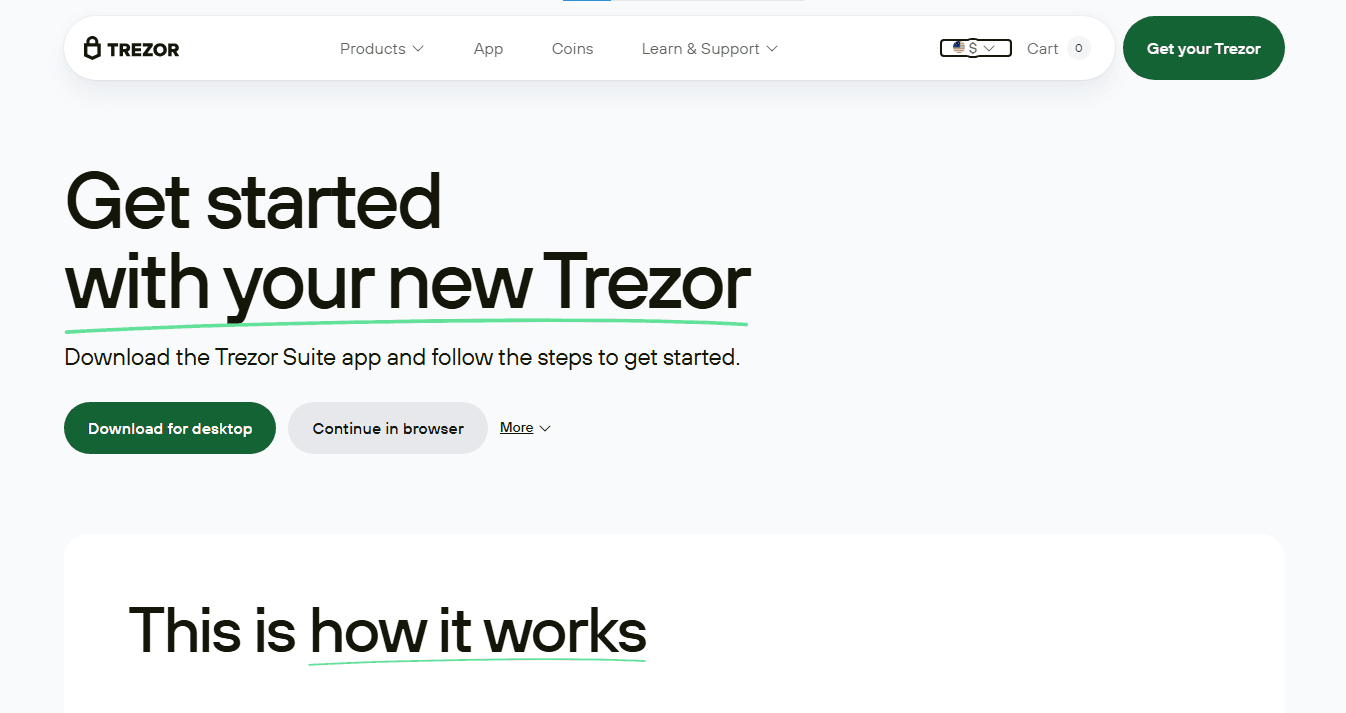
Step 2 — Download and open Trezor Suite
Available for Windows, macOS, and Linux.
After installation, open the application.
Step 3 — Connect your Trezor device
Use the original USB cable to avoid connection issues.
Once connected, Trezor Suite will detect your device.
Step 4 — Enter your Trezor PIN
Your device itself displays the PIN matrix.
You must enter the corresponding numbers inside Trezor Suite.
This PIN protects your wallet from unauthorized physical access.
Step 5 — Enter your passphrase (Optional but recommended)
If enabled, the passphrase acts as a second login layer, creating a hidden wallet.
Each unique passphrase unlocks a different account.
Step 6 — Access Trezor Suite Dashboard
Once your device is unlocked, you can:
View cryptocurrency balances
Manage multiple accounts
Send or receive crypto
Update firmware
Adjust security settings
This is the “login state” of Trezor—you’re now fully authenticated.
Does Trezor Have an Online Login Page?
No.
There is no online username/password login website.
If you encounter a website claiming to offer “Trezor login,” it is almost certainly a phishing scam designed to steal your recovery seed.
Always avoid:
❌ Login portals
❌ Web-based dashboards
❌ Sites asking for seed phrases
❌ Browser pop-ups requesting device info
❌ Chrome extensions pretending to be Trezor
The official software is Trezor Suite only.
Understanding Trezor PIN – Your Primary Login Method
Your PIN is the main layer of device protection.
PIN rules:
Must be entered every time you reconnect the device
Maximum of 16 digits
Wrong attempts increase waiting time
Ten incorrect tries wipe the device (protecting your funds)
Important:
The PIN entry matrix displayed on Trezor Suite is scrambled every time, so malware cannot record your input pattern.
Using a Passphrase – Advanced Trezor Login Layer
The passphrase is like having a secret wallet inside your main wallet.
Benefits:
Protects against physical theft
Protects against someone seeing your recovery seed
Allows multiple hidden wallets
Example:
Passphrase “OceanBlue” opens a different wallet than “OceanBlue1.”
Each passphrase = Different wallet
No passphrase = Standard wallet
Passphrases are never stored on the device.
You must remember them—Trezor cannot recover them for you.
Trezor Login Through Web Browser (Deprecated Method)
Years ago, Trezor worked through Trezor Bridge + browser.
Today, the preferred and safest method is Trezor Suite App.
Some browser tools still exist, but Trezor recommends using Suite for security and compatibility.
Trezor Login Problems and How to Fix Them
Below are the most common login issues and their solutions.
1. Trezor Not Detected by Trezor Suite
Try:
Switching USB cables
Using a different USB port
Restarting Trezor Suite
Reconnecting your device
Updating your OS
Reinstalling Trezor Suite
Often it’s simply a cable issue.
2. Forgot Your PIN
If you forget your PIN:
You must wipe the device
Then restore with your recovery seed
Your funds will return once the correct seed is restored.
3. Forgot Your Passphrase
This cannot be recovered.
A forgotten passphrase means permanent loss of access to that hidden wallet.
4. Trezor Asking for Firmware Update
Sometimes Trezor won’t allow login until firmware is updated.
Follow the on-screen instructions and do not disconnect the device during updates.
5. Incorrect Recovery Seed
If restoring your wallet fails:
Check spelling
Ensure correct word order
Verify you used the right recovery seed
Make sure the seed belongs to your Trezor
24-word seeds must be exact.
Security Tips for a Safer Trezor Login
Your Trezor login is only as strong as your personal security habits.
✔ Protect your recovery seed
Never take photos or type it into your phone or computer.
✔ Enable Passphrase
This prevents access even if someone steals your seed.
✔ Use a strong PIN
Avoid patterns like 1111 or 1234.
✔ Keep Trezor Suite UPDATED
Updates fix security vulnerabilities.
✔ Verify receiving addresses on your device
Prevents malware from replacing addresses.
✔ Don’t plug your Trezor into unknown or public computers
Use trusted devices only.
Does Trezor Store Login Information?
No.
Trezor stores no:
Emails
Passwords
Personal data
Online login profiles
Cloud-based wallets
Everything happens locally, through your hardware device.
How to Log Out of Trezor
Logging out is automatic.
To log out:
Disconnect the Trezor device from your computer
Trezor Suite immediately locks access
Without the physical device, no one can log in.
Final Thoughts – Trezor Login Is About Device Security, Not Online Accounts
The concept of a “Trezor login” is different from typical crypto platforms.
Instead of online accounts and passwords, your hardware wallet is your login key.
To access your crypto safely:
Use Trezor Suite
Unlock with PIN
Protect with passphrase
Keep your recovery seed offline
Following these principles ensures your cryptocurrency remains secure, private, and fully controlled by you.