Trezor Login –
Cryptocurrency ownership comes with a unique responsibility: protecting your digital assets. Unlike traditional banking or online trading platforms, hardware wallets like Trezor provide offline security for your crypto. However, many new users are confused when they search for “Trezor login.” Unlike web-based platforms, Trezor doesn’t rely on email-password combinations. Instead, login and access rely on hardware authentication, PINs, passphrases, and the Trezor Suite software.
This comprehensive guide will explain:
What a Trezor login actually is
How to access your wallet safely
Step-by-step Trezor login instructions
Troubleshooting common login issues
Advanced security techniques
Best practices for long-term crypto protection
By the end, you’ll understand how to access your wallet confidently and securely.
Understanding the Concept of Trezor Login
When people refer to “Trezor login”, they are usually talking about one of the following:
Unlocking a Trezor device with a PIN
Accessing a hidden wallet with a passphrase
Connecting the device to Trezor Suite to manage assets
Unlike traditional logins, Trezor doesn’t have an online username-password portal. Your authentication is local, meaning your private keys never leave the device, ensuring maximum security.
Think of your Trezor device as both the key and the lock to your crypto vault. Without it (and your PIN/passphrase), nobody can access your funds.
Why Trezor Login Is Different from Traditional Logins
Unlike exchanges such as Coinbase or Binance:
No email/password is stored online
No cloud account stores your wallet
All authentication happens locally on the hardware
Trezor Suite is merely the interface for viewing balances, sending/receiving crypto, and managing settings
This design significantly reduces your risk of hacking because even if a hacker compromises your computer, your wallet cannot be accessed without the physical device and PIN.
Step-by-Step Guide to Logging Into Your Trezor Wallet
Here’s a detailed walkthrough for accessing your Trezor wallet safely.
Step 1 — Prepare Your Trezor Device
Before login:
Ensure your device is untampered and authentic
Use the original USB cable
Avoid connecting to public or unknown computers
Physical security is the first layer of protection.
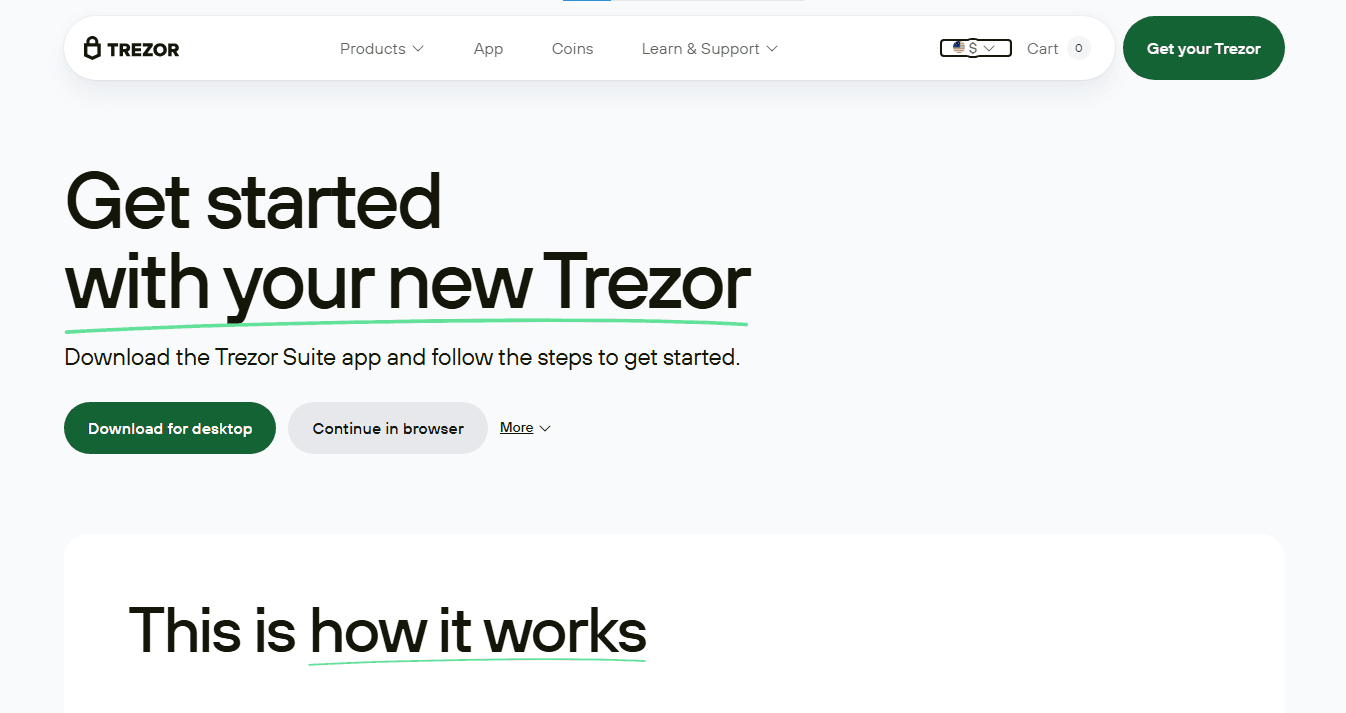
Step 2 — Download Trezor Suite
Go to Trezor.io/start.
Select your device model: Trezor One or Trezor Model T
Download the latest version of Trezor Suite for your operating system (Windows, macOS, Linux)
Install the application following on-screen instructions
Important: Never download from third-party sources to avoid malware.
Step 3 — Connect Your Trezor Device
Plug your Trezor into your computer with the provided USB cable.
Once connected:
The device powers on
You may see prompts to install firmware updates (if required)
Step 4 — Enter Your PIN
The PIN is the primary access method for Trezor:
Your Trezor device shows a PIN matrix
Enter numbers on Trezor Suite corresponding to the matrix
The PIN length is customizable and can go up to 16 digits
Security Note:
The PIN matrix is scrambled each time, preventing malware from recording patterns.
Step 5 — Enter Passphrase (Optional but Recommended)
A passphrase provides a hidden wallet feature:
Each passphrase unlocks a different wallet
Even if someone steals your recovery seed, they cannot access the hidden wallet without the passphrase
Example:
Passphrase “OceanBlue” → Hidden Wallet A
Passphrase “OceanRed” → Hidden Wallet B
This adds a critical second layer of security.
Step 6 — Access Trezor Suite Dashboard
After authentication, Trezor Suite unlocks full functionality:
View cryptocurrency balances
Send and receive crypto securely
Create and manage multiple accounts
Update firmware
Adjust device security settings
At this stage, you are effectively “logged in.”
Recovering a Trezor Wallet (Login Without Device)
If you lose your Trezor:
Purchase a new device
During setup, select Recover Wallet
Enter your 24-word recovery seed
Optionally, enter any passphrase used
This process restores access to all funds. Without the recovery seed, login is impossible.
Common Trezor Login Issues and Solutions
Even experienced users may encounter issues. Here are the most common problems:
1. Trezor Not Detected by Suite
Causes:
Loose or faulty USB cable
Driver issues
Outdated Suite version
Fix:
Try a new USB cable or port
Restart Trezor Suite
Update your operating system and Suite
2. Forgot PIN
Solution:
You must wipe the device
Restore wallet using recovery seed
Remember: PIN is critical; forgetting it without a seed results in temporary device lock.
3. Forgot Passphrase
Cannot recover forgotten passphrase
Funds in hidden wallets become inaccessible
Recommendation: Store passphrases offline in a secure place.
4. Firmware Update Required
Trezor Suite may block login until the device has the latest firmware
Follow on-screen instructions carefully
Never disconnect during firmware update
5. Incorrect Recovery Seed
Ensure word order and spelling are correct
Make sure you’re using the seed for the correct device
Advanced Security Practices for Trezor Login
For high-value wallets or long-term storage, consider the following:
1. Use Passphrase Hidden Wallets
Protects funds if seed is stolen.
2. Use Metal Backup
Store recovery seed on metal cards to prevent fire or water damage.
3. Enable Strong PIN
Avoid simple sequences or patterns.
4. Always Verify Addresses
Check receiving addresses on the device screen before sending crypto.
5. Keep Trezor Suite Updated
Firmware and software updates patch security vulnerabilities.
6. Avoid Public Computers
Never plug Trezor into shared or untrusted systems.
Trezor Login for Multiple Devices
Trezor allows multiple devices to access the same wallet:
Connect different Trezor devices
Use the same recovery seed to unlock accounts
Optional passphrase ensures unique hidden wallets per device
This is useful for backup devices or family accounts.
Does Trezor Require Online Login?
No. There is no online account or cloud login.
Your funds are never stored online
Your private keys never leave the device
Trezor Suite is only a management interface
Any website claiming to offer “Trezor login” is almost certainly a phishing attempt.
Logging Out of Trezor
Logging out happens automatically:
Disconnect the device from your computer
Suite locks immediately
PIN or passphrase is required to log back in
No online credentials are needed to log out.
Conclusion: Trezor Login Is About Device Authentication, Not Online Accounts
Understanding Trezor login is crucial for both beginners and advanced users:
Login = connecting the device + entering PIN + optional passphrase
No username/password combination exists
All security occurs offline
By combining Trezor Suite, PIN, passphrase, and best security practices, users can safely manage crypto with confidence. The Trezor login system exemplifies true self-custody: your funds are always in your control, never stored online.
Next Steps After Trezor Login
Once you’ve logged in:
Check balances
Send or receive crypto securely
Update firmware
Configure passphrase wallets if needed
Set up regular backups
Following these steps ensures your Trezor login process is not only successful but also safe for long-term crypto management.